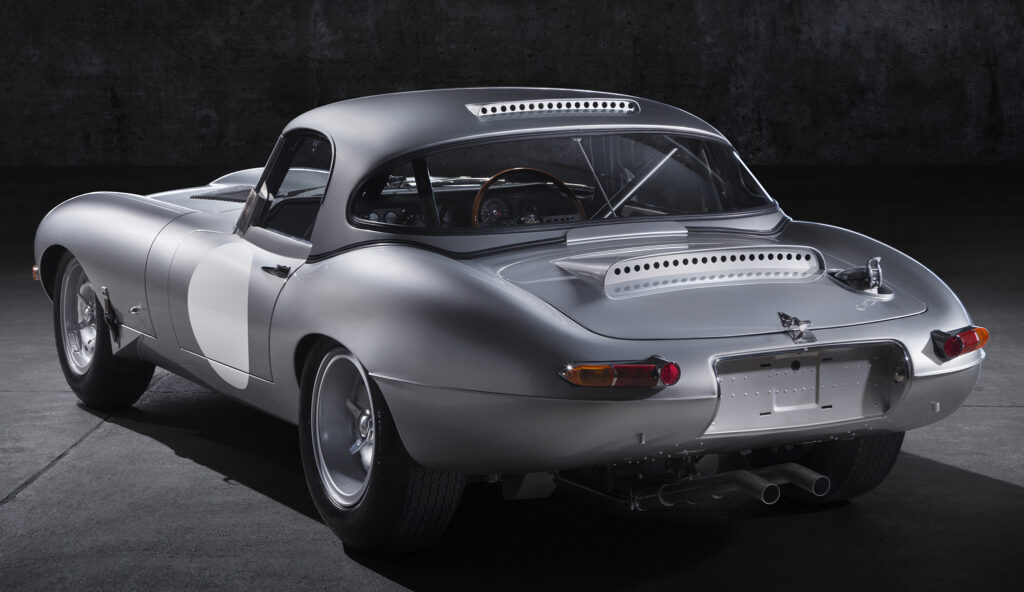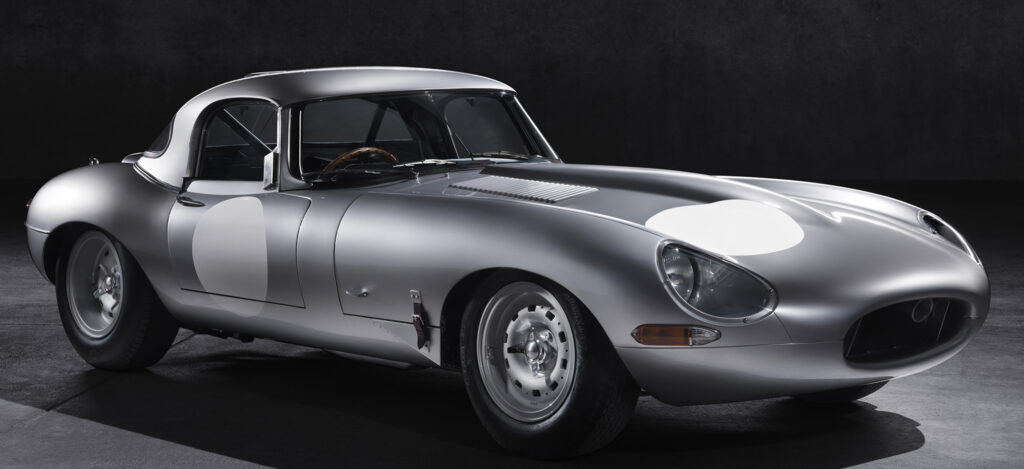
Jaguar has revealed the prototype of its ‘new’ Lightweight E-type – a further six of which will be built and sold.
Jaguar announced in May 2014 that it would recreate six new Lightweights, each built by Jaguar Heritage, part of Jaguar Land Rover’s new Special Operations division.
Each of the six cars will be built to a specification originated from the last Lightweight E-type produced in 1964 and will be hand-crafted at the original home of the E-type, Jaguar’s Browns Lane plant in Coventry, England. The cars will be sold as period competition vehicles and all will be suitable for FIA homologation for historic motorsport purposes.
The new cars are the ‘missing’ six vehicles from the ‘Special GT E-type’ project, which originally started in February 1963 with the objective of building 18 cars. Only 12 of the aluminium-bodied Lightweight E-types were eventually built and the remaining six designated chassis numbers having lain dormant, until now. The six new cars will carry those original, historic Lightweight E-type chassis numbers.
A race winner in the hands of a variety of famous drivers during its short competitive career, the car has achieved worldwide fame and original examples are now valued in the many millions. In recreating the Lightweight E-type, Jaguar Heritage has been able to call on the superlative skills and experience of many talented engineers and technicians already working in a variety of departments within Jaguar.
All, when offered the chance to assist with this unique project, leapt at the opportunity. Some even have an indirect link with the E-type when it was new: one master technician calculated that his family – including his grandparents, his father and his uncle – had a collective 170 years’ service at Jaguar stretching back to the early 1960s.
The expertise and attention brought to bear on this recreation project is staggering, with the full resources of Jaguar being applied to ensure that the six new Lightweights will not only be authentic, but will also be built to the highest quality standards.
So the six chosen customers will each receive the rarest of things – a brand new Lightweight E-type, hand-built at Browns Lane and just as desirable as one of the originals.
“Operating from a brand new workshop at Browns Lane – now open for the restoration and servicing of customer cars – the building of six new, meticulously crafted Lightweight E-type period competition cars by Jaguar Heritage is testament to the unique skills within the team. To know those same skills can also be utilised to the benefit of existing classic Jaguar owners means this is a very exciting time for Jaguar Heritage.”
Engine System
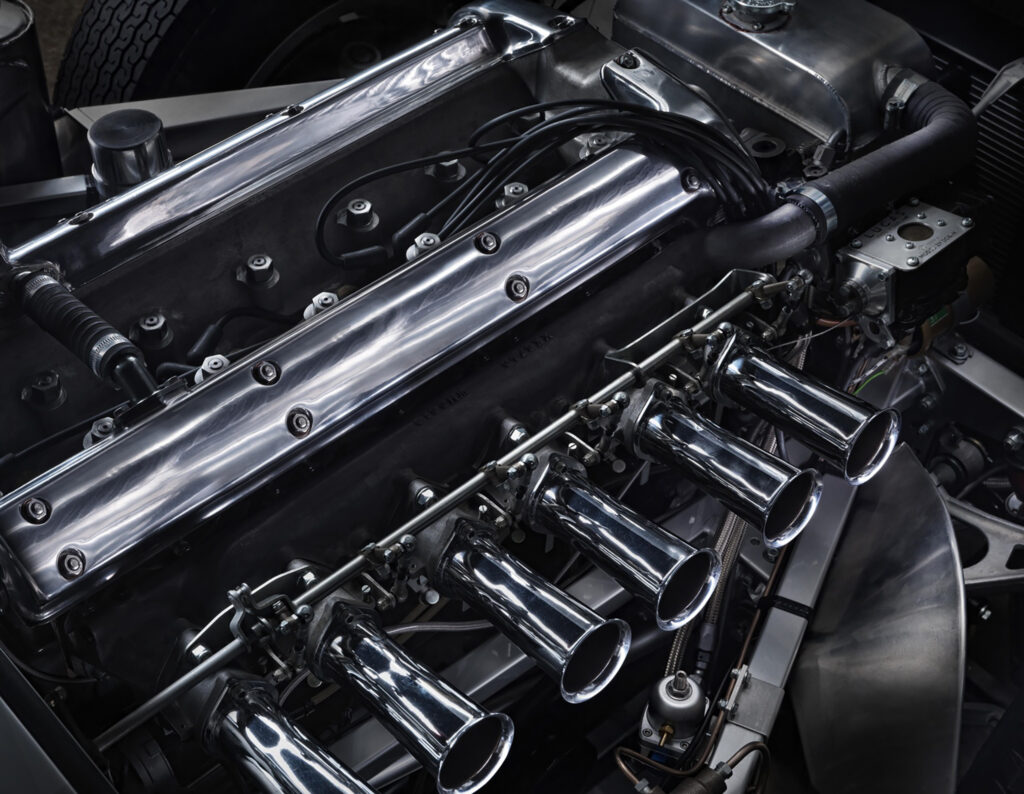
Engine: Aluminum six‑cylinder block, wide‑angle cylinder head, dry sump lubrication, lightweight low‑inertia flywheel
Displacement: 236.0 cu in (3,868cc)
Bore/Stroke: 3.46in/4.17in (88.0mm/106.0mm)
Valvetrain: 2 valves per cylinder, DOHC
Compression ratio: 10:1
Carburetors: Triple 45 DCOE Weber
Injection (optional): Lucas mechanical, 6.25in (158.7mm) butterfly trumpets
Crankshaft: Steel with steel H‑section connecting rods
Power: 340hp/253.5kW @ 6500rpm
Torque: 280lbs ft/380Nm @ 4500rpm
Fuel tank: Mesh‑filled 14‑gallon (64‑liter) capacity
Fuel pump: Standard E‑Type
Transmission and Driveline
Transmission: Jaguar 4‑speed fully synchronized close‑ratio gearbox
Final drive casing: Cast iron, Powr‑Lok limited slip differential, axle ratio 3.31:1
Gearbox oil: Castrol
Clutch: Single dry plate
Suspension and Steering
Front: Double wishbone, LWE torsion bars, upgraded anti‑roll bar
Rear: Independent rear suspension, lower wishbones with the driveshaft acting as upper links, radius arms, anti‑roll bar (Standard E‑type rear springs with uprated shock absorber assemblies)
Steering: Standard E‑Type rack‑and‑pinion, adjustable steering column
Brakes
Brake discs (front): 12.00‑inch Diameter (305mm)
Brake discs (rear): 11.25‑inch Diameter (286mm)
Handbrake: Production E‑Type
Wheels and Tires
Magnesium wheels: Front: 15‑inches x 7.0J, Rear 15in x 8.0J
Tires: Front ‑ 6.00L15 CR65, Rear ‑ 6.50L15 CR65
Electrical
Battery: 12v ‑ 62 amp / hour
System: 12v negative‑ground
Lighting: Tungsten headlamps and standard rear tail‑lamps
Ignition: Electronic
Instruments: Smiths Industries
Generator: Production E‑Type
Starter: Production E‑Type
Control Box: Production E‑Type
Wiper motor
and blades: Production E‑Type
Exhaust and Cooling
Exhaust: Fabricated steel manifold, steel exhaust system with center silencer box and twin polished tail pipes
Cooling: Aluminum E‑Type radiator, aluminum expansion header tank, engine oil cooler, oil sump tank
Overview
Length: 175.3‑inches (4,453mm)
Width: 66.9‑inches (1,700mm)
Height: 46.5in‑inches (1,181mm)
Weight: 2204.6lbs (1,000kg)
Wheelbase: 96.1‑inches (2,440mm)
Front Track: 50.0‑inches (1,270mm)
Rear Track: 55.0‑inches (1,397mm)
BODY TRIM & HARDWARE
Body in white & closures
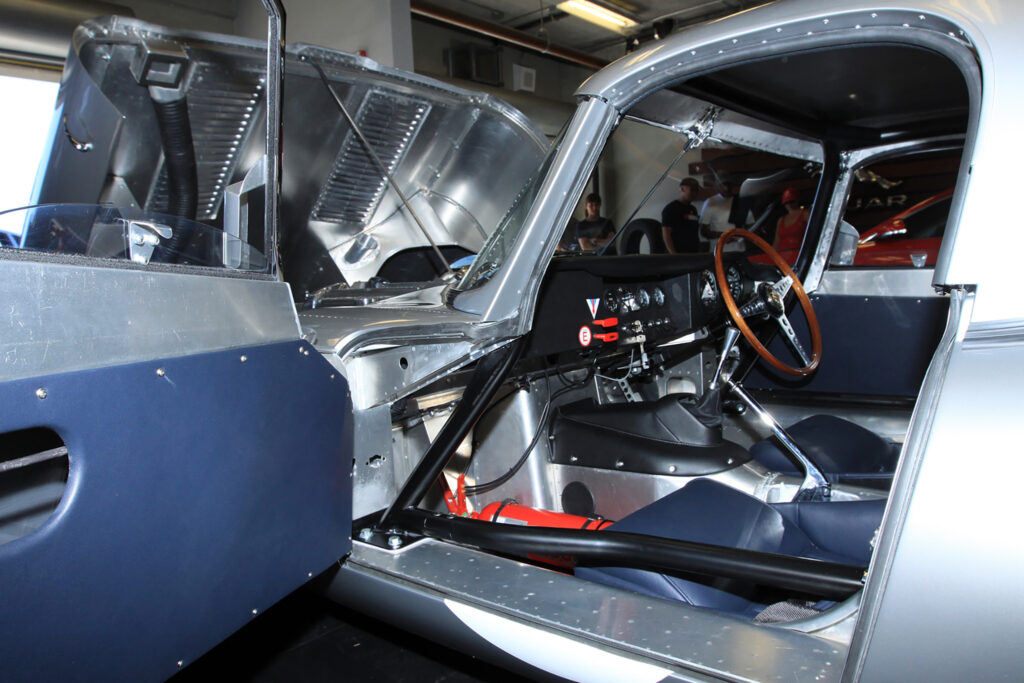
- Aluminum unibody with stiffened front sub‑frame for race engines above 300hp
- Riveted and welded aluminum construction
- Aluminum body closures (hood/doors/trunk‑lid)
- Aluminum detachable hard top roof
- 21 louver hood vents
- Black powder‑coated roll cage
- Front brake cooling ducts integrated in hood structure
Exterior trim
- Side hood‑release handles
- ‘Long range’ aluminum quick release fuel cap
- Body color cabin ventilation air intakes
- Protective car cover (non‑waterproof)
- Center hood safety catch
- Oval door mirror upgrade
Interior Trim
- Aluminum bucket seats with increased backrest angle and padded cushions
- Rear‑view mirror
- Leather selection from Connolly palette
- Wood‑rimmed steering wheel
- Aluminum gear knob and standard hand brake
- Machined metal center panel with toggle switches and push button starter
- Five‑point competition seat belt harness
- Black instrument panel with glove box
- Hood and trunk stands
Greenhouse Glass
- Clear laminated front windscreen
- Perspex® (Polymer) side windows and rear screen
- Manual slide side windows