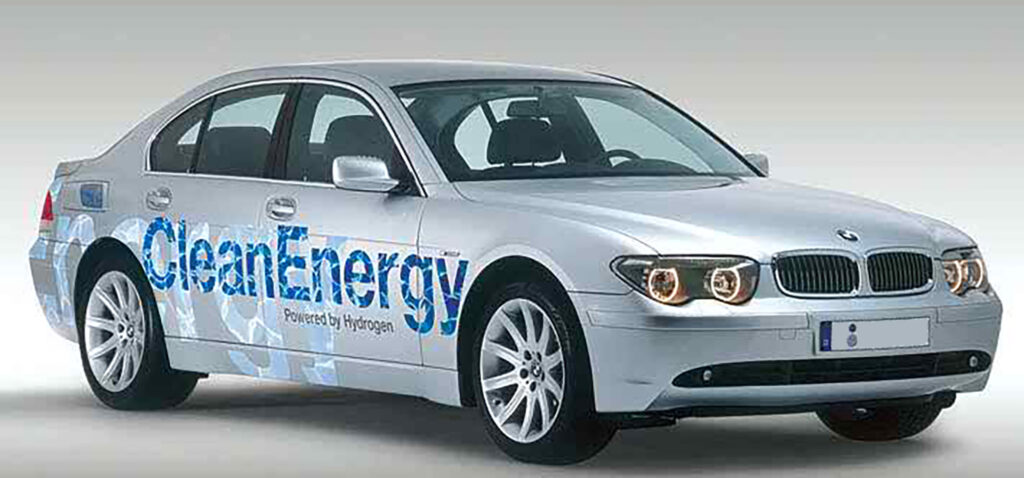
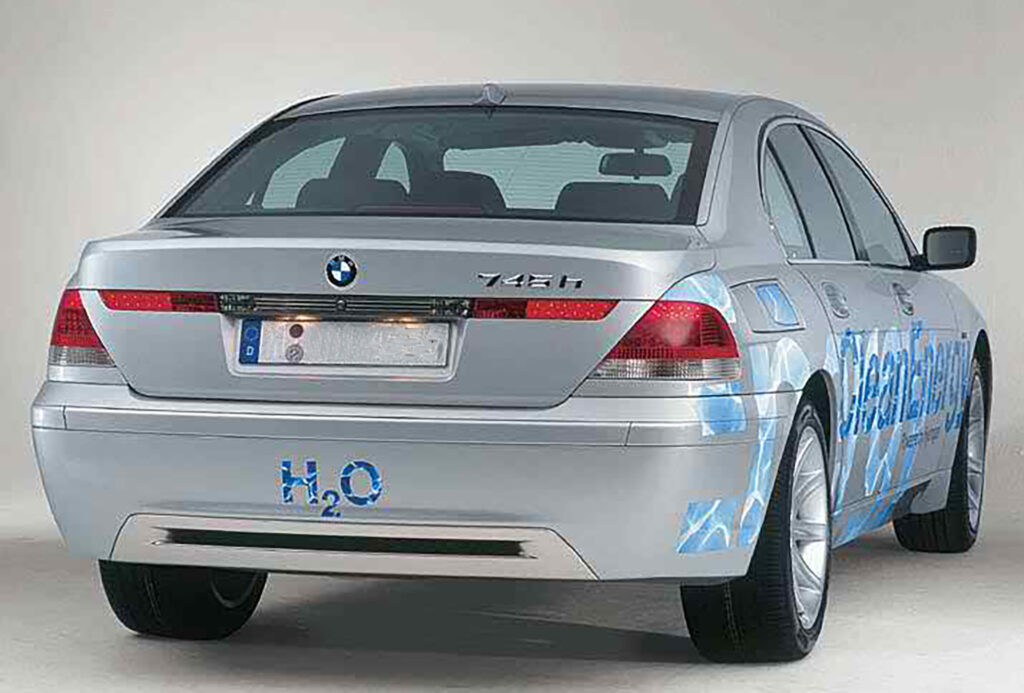
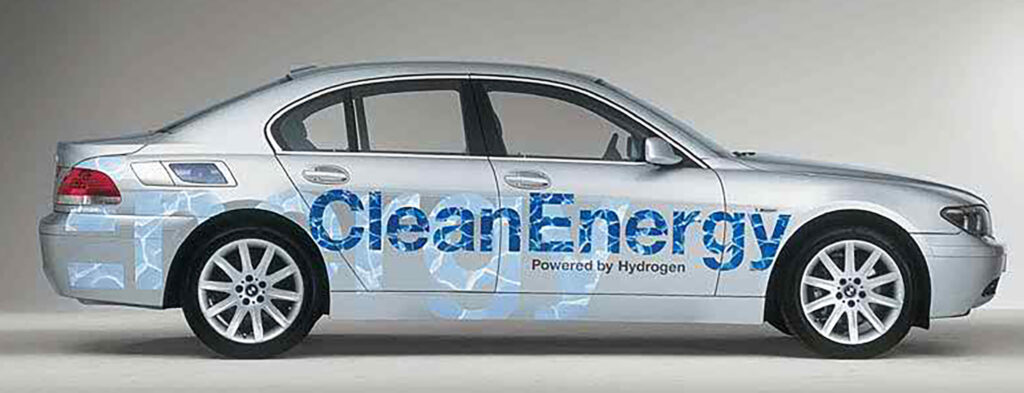
BMW is making major progress towards the next generation of hydrogen powered cars. The 745h represents the 6th BMW model to utilize the hydrogen drive technology. BMW claims the technology used in the 745h and other hydrogen models is suffieciently advanced to permit realistic large-scale production. However, hydrogen can only be a sensible alternative to gasoline if the electricity needed to generate it can be produced with renewable energy sources, such as solar, wind or hydroelectric power. Such energy sources combined with hydogen drives would yeild a zero emmission transportation system. Hydrogen burns without generating any CO2 emissions, that is the emissions responsible for the greenhouse effect & global warming.
The 745h contains the world’s first V8 that can be powered by both hydrogen & gasoline. The V8 is largely identical to the series production v8, utilizing bi-VANOS, VALVETRONIC and the fully Varibale Intake Manifold to reduce fuel consumtion. The hydrogen fuel source is a double-walled steel tank behind the rear seat-backs. The hydrogen is stored cryogenically – that is, in superchilled and liquid form – at a temperature of around minus 250 degrees. Two safety valves ensure controlled ventilation in the case of excess pressure. They are also part of the comprehensive safety concept which proved its reliability in numerous crash tests. Even in the case of a massive rear-end collisions in which the tank was impacted, the steel cylinder with dual, 2mm-thick walls, did not leak.
A further prerequisite for the introduction of hydrogen as fuel is a filling system which must be no more complicated than filling a car today. The low temperature of minus 250 degrees Celsius requires a special type of filling station. BMW has developed appropriate technology which is currently being demonstrated by the world’s first public robot fuel station for liquid hydrogen at the Munich airport. The fully automatic hydrogen fuelling operation takes less than three minutes and is a simple process.
type
Series Production Car
built at
Munich, Germany
engine
Bi-Fuel V8
valvetrain
4 Valves / Cyl w/BiVANOS & VALVETRONIC
displacement
4398 cc / 268.4 in³
bore
92 mm / 3.62 in
stroke
82.7 mm / 3.26 in
power
137.2 kw / 184.0 bhp
specific output
41.84 bhp per litre
front brakes
Discs
rear brakes
Discs
transmission
6-Speed Auto
top speed
~214.0 kph / 133.
Engine
Configuration
90º V8
Location
Front, longitudinally mounted
Displacement
4,398 cc / 268.4 cu in
Bore / Stroke
92.0 mm (3.6 in) / 82.7 mm (3.3 in)
Valvetrain
4 valves / cylinder, DOHC, w/ double VANOS
Fuel feed
Fuel Injection
Aspiration
Naturally Aspirated
Power
184 bhp / 137 kW
BHP/Liter
42 bhp / liter
Drivetrain
Chassis
unitary steel
Front suspension
double-joint thrust-rod spring strut axle in aluminium, compensation of lateral forces, anti-dive
Rear suspension
integral-IV multi-arm axle in aluminium, three-dimensional wheel suspension with anti-dive and anti-squat, self-levelling air suspension
Steering
rack-and-pinion, speed sensitive, power assisted
Brakes
ventilated discs, all-round, ABS
Gearbox
6 speed Automatic
Drive
Rear wheel drive
Dimensions
Length / Width / Height
5,029 mm (198 in) / 1,902 mm (74.9 in) / 1,492 mm (58.7 in)
Wheelbase / Track (fr/r)
2,990 mm (117.7 in) / 1,586 mm (62.4 in) / 1,590 mm (62.6 in)