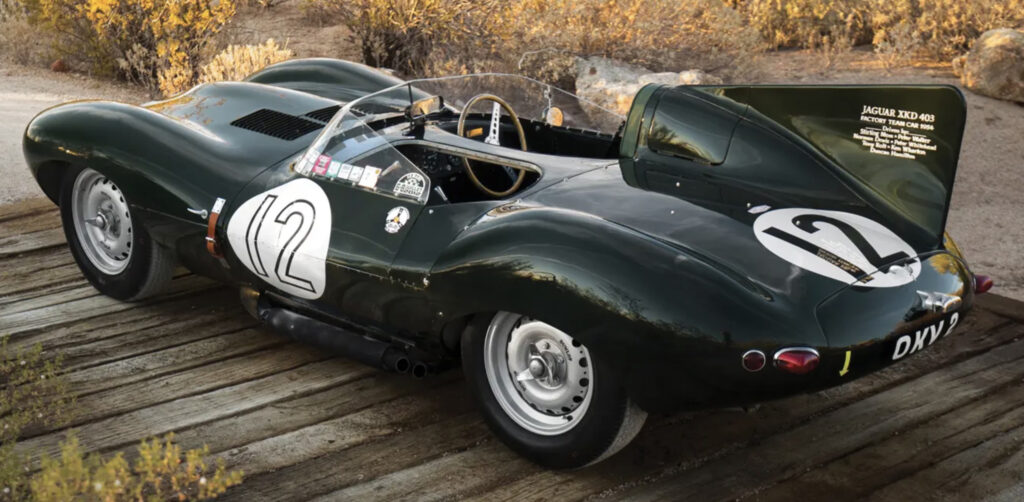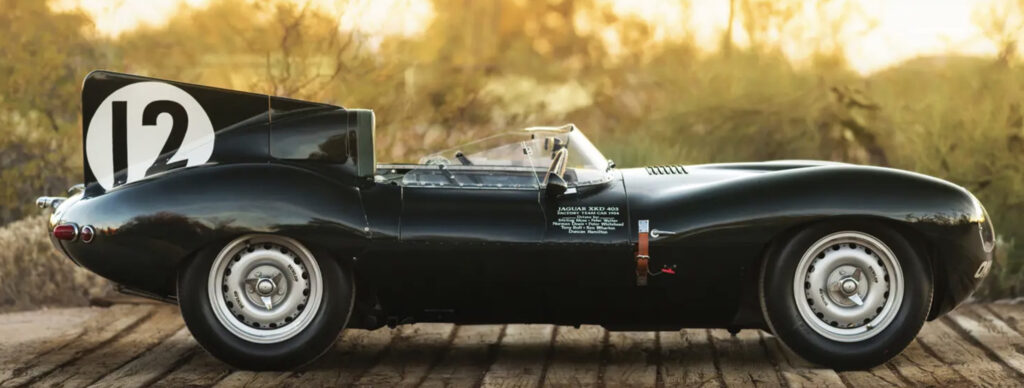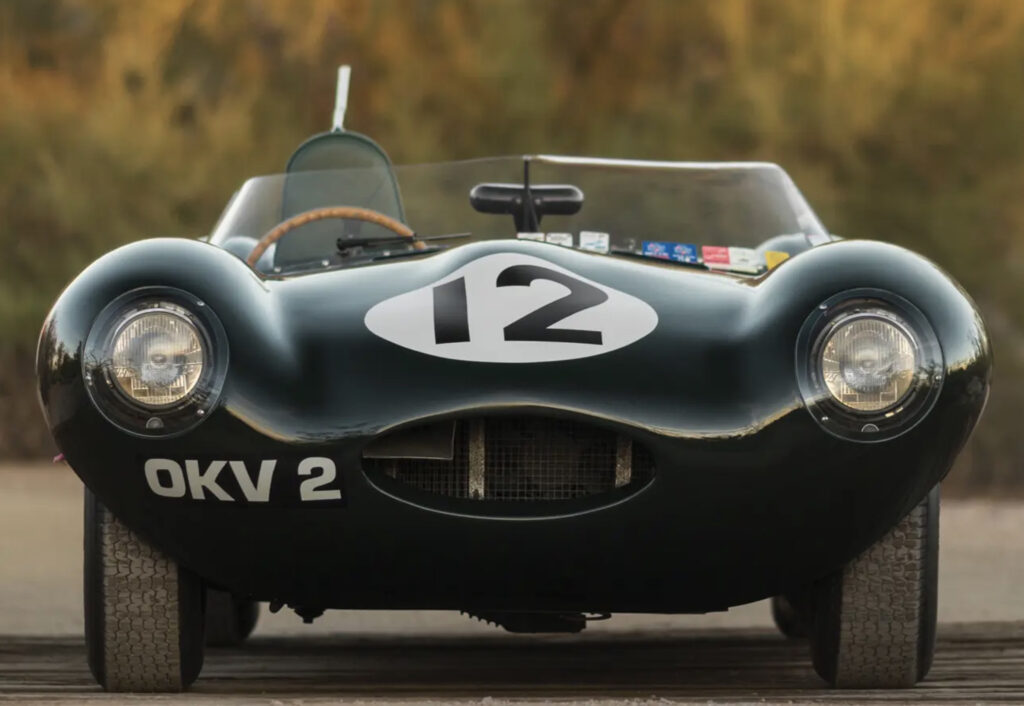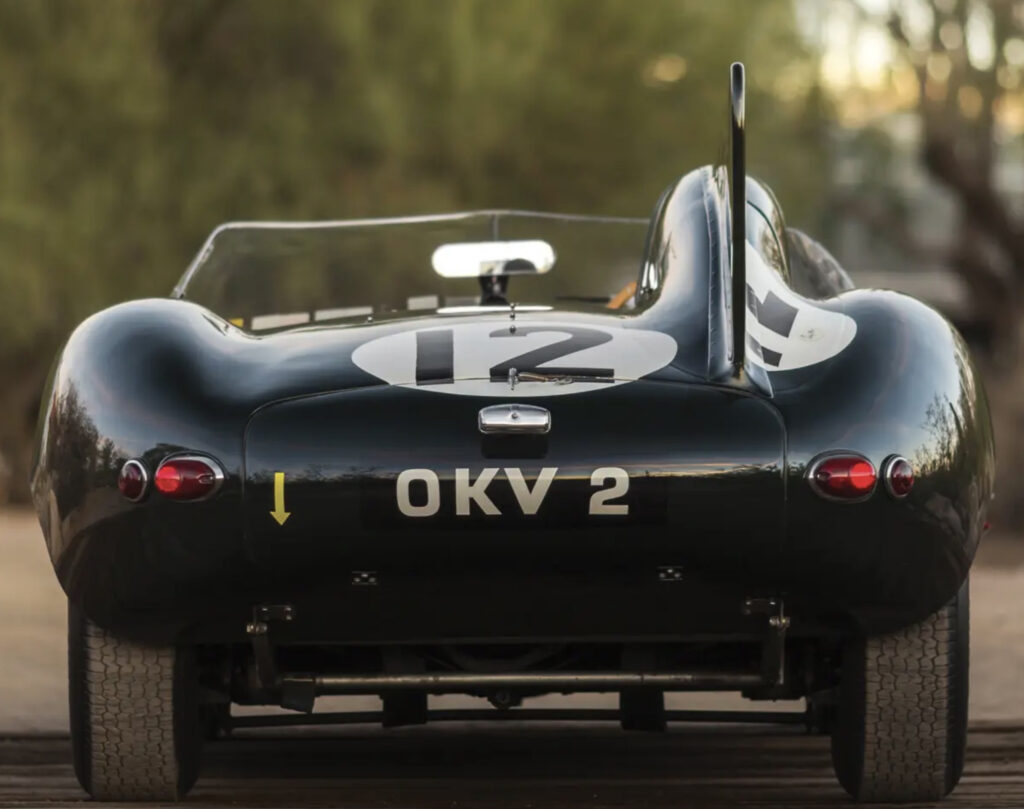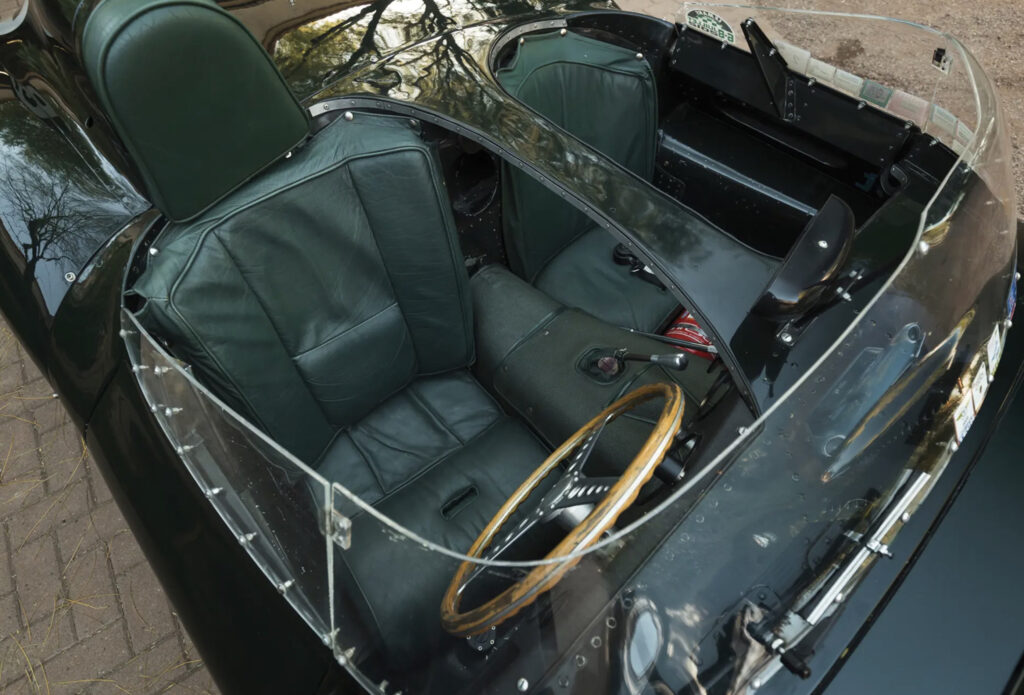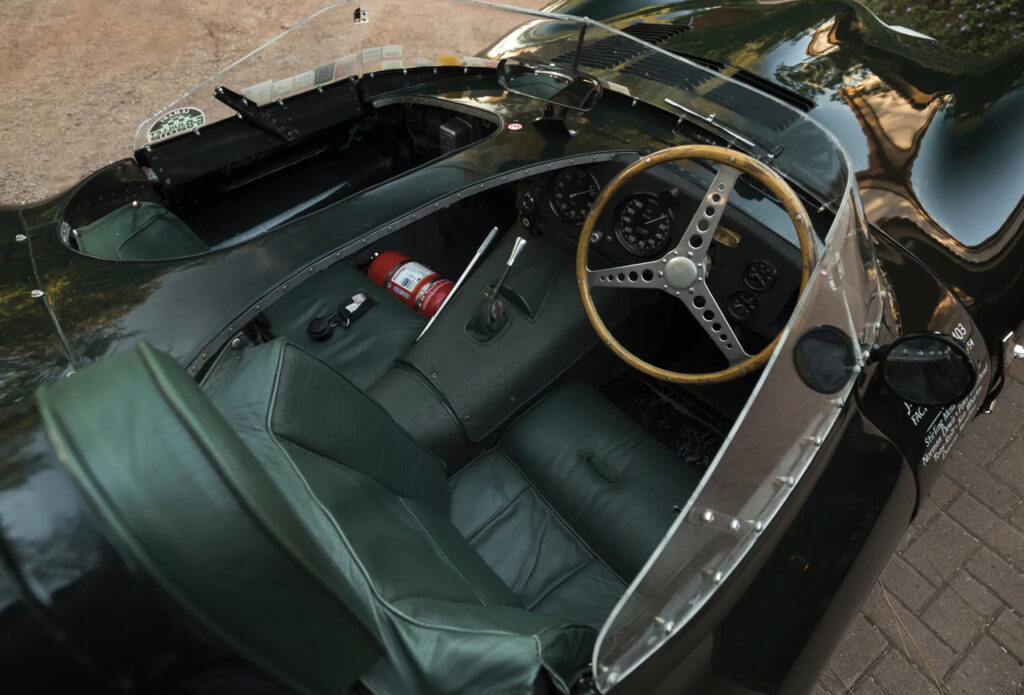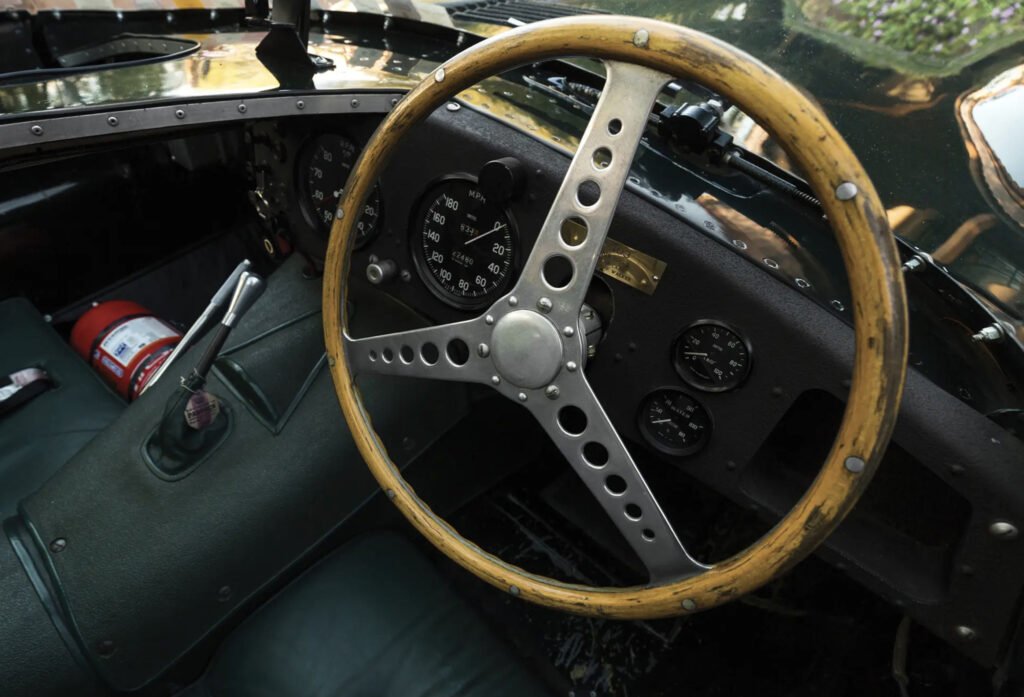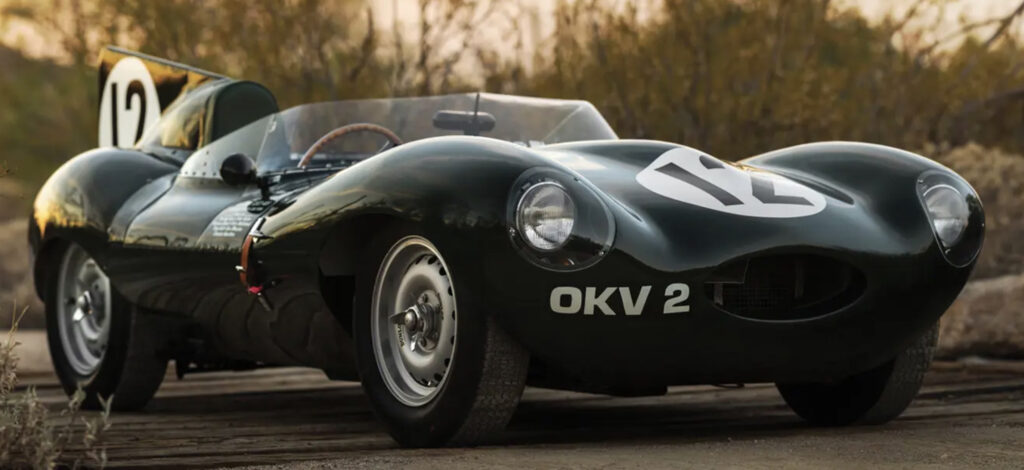
Continuing their successful motor sports program, Jaguar created the D-Type as a logical progression of the XK120C, or C-Type. After an eighteen month development period, the D-Type was launched and intended to assault the 1954 Le Mans. It won the event three years in a row and became Jaguar’s most successful race car.
After three privately entered XK120s proved competitive at LeMans, Jaguar was motivated to move forward with their own purpose built race car. The result was the XK120C, a car which would win at its very first event, the 1951 24 Hour of Le Mans. This result was achieved again in 1953, with the final version of the XK120-C which featured disc brakes – an automotive first in GT racing.
Even before 1953 victory at Le Mans, it became clear to Jaguar that a new car would be necessary to stay ahead of Ferrari, Alfa Romeo, Aston Martin and Maserati. Sir Williams Lyons, the founder of Jaguar, assembled a team of Engineers including Malcom Sayer, an aviation aero dynamist, to create the all-new D-Type.
Design requirements for the D-Type said it should be lower and shorter that its predecessor. This would help the car achieve a higher top speed and increased cornering capability. Most of the form for the car came from mathematical computation with the help of Malcom Sayer. Initial tests on the unpainted prototype car, chassis XKC401, revealed a top speed of 178 mph, almost 30mph faster than the Type-C!
At the heart of the D-Type was an innovative chassis structure. It used stressed-skin engineering, incorporating the framework with riveted aluminum body panels to form a single rigid structure. Such design made the D-Type one of the first cars to use monocoque construction. As on the C-Type, both the front and rear panels of the car remained unstressed and easily removable for repairs.
The 1954 D-Type used a magnesium alloy for it’s body, framework and suspension. While this did keep weight down, it made production expensive and repairs even more expensive. By 1955 these materials were replaced by simple aluminum and steel counterparts.
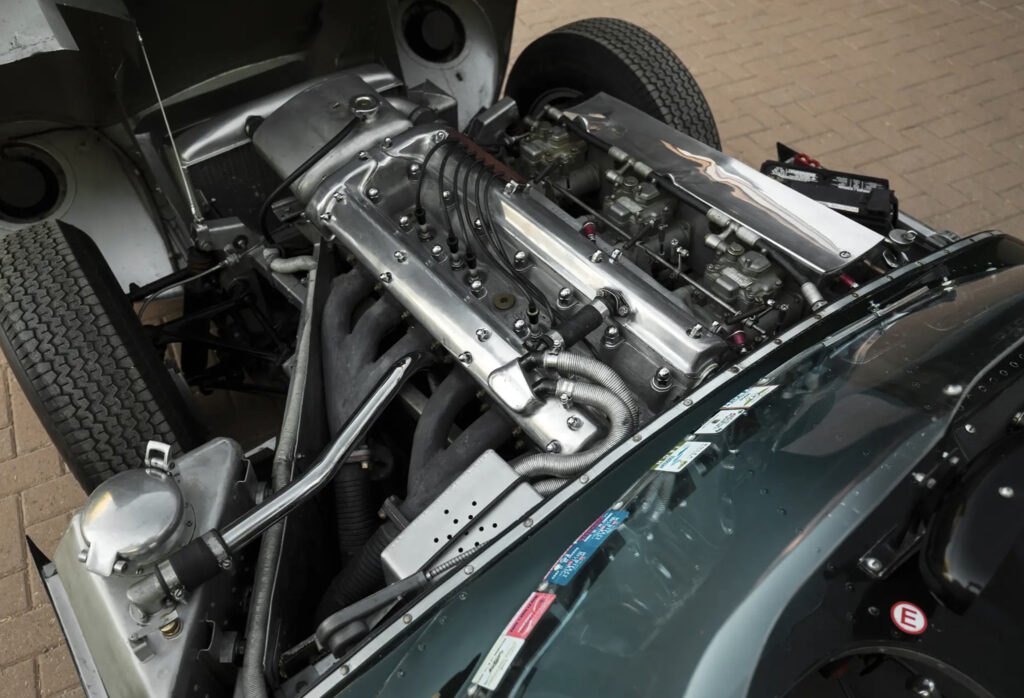
The XK-based engine powering the D-Type played a large role in helping achieve a high top speed. It was both shorter, thanks to dry-sump lubrication, and more powerful than the previous engines. The combination of a revised block, larger valves and triple Weber carburetors helped the engine achieve 245 bhp.
Dunlop disc brakes were employed to all four wheels. Jaguar worked exclusively with Dunlop during the fifties to adapt aircraft disc brakes to road cars. In 1953 the first use of disc brakes was witnessed on the C-Type works cars. It was this potent feature that helped the C-Type achieve victory at the 1953 Lemans.
Suspension of the D-Type type used double wishbones up front with a rigid axle in the rear. This was the familiar setup found on all production Jaguars during the period.
Despite being created even before the 1953 Le Mans, the D-Type made it first appearance the following year. Three chassis, #402, #403 and #404 were created after the prototype to specifically race in the 1954 24 Hours of Le Mans.
Driving the three cars were teams made up of Tony Rolt with Duncan Hamilton, Stirling Moss with Peter Walker and Peter Whitehead with Ken Wharton. Unfortunately, two cars dropped out early with brake and transmission problems. The final car, driven by Hamilton and Rolt showed promising resilience, but ended up finishing two minutes behind a 4.9-liter Ferrari. It was one of the closest finishes ever and a bitter disappointment for Jaguar who made Le Mans the point of their competition effort.
Jaguar made up for their losses in 1955, but it was completely overshadowed by the Le Mans tragedy and was only possible with the the withdrawal of Daimler-Benz A.G. and their Mercedes-Benz 300 SLR.
In 1956, Jaguar officially supported teams such as Ecurie Ecosse while they converted the racing department into developing the E-Type. During this time several updates were carried out on the D-Type to keep it competitive. With private entrant E-Types won Le Mans outright with Ecurie Ecosse in 1956 and 1957. During the later, they swept the podium at the 1956 24 Hours of Le Mans with Ron Flockhart and Ivor Bueb of Ecurie Ecosse winning outright. Late in 1957 Jaguar was even considering making a fiberglass body for the 1958 car.
| type | Racing Car |
| built at | Coventry, England |
| engine | Cast Iron Inline-6 |
| position | Front Longitudinal |
| aspiration | Natural |
| valvetrain | DOHC 2 Valves / Cyl |
| fuel feed | 3 Weber 45 DC03 3 Weber DC03 Carburetors |
| displacement | 3442 cc / 210.0 in³ |
| bore | 83 mm / 3.27 in |
| stroke | 106 mm / 4.17 in |
| compression | 9.0:1 |
| power | 182.7 kw / 245 bhp @ 6500 rpm |
| specific output | 71.18 bhp per litre |
| bhp/weight | 291.67 bhp per tonne |
| torque | 325.4 nm / 240 ft lbs |
| body / frame | Magnesium Alloy Monocoque w/Steel Front Subframe |
| driven wheels | RWD |
| front tires | 6.5×16 |
| rear tires | 6.5×16 |
| front brakes | Dunlop Discs |
| rear brakes | Dunlop Discs |
| front wheels | F 40.6 x 14.0 cm / 16 x 5.5 in |
| rear wheels | R 40.6 x 14.0 cm / 16 x 5.5 in |
| steering | Rack & Pinion |
| f suspension | Double Wishbones w/Torsion Bars, Telescopic Dampers |
| r suspension | Solid Axle w/Trailing Links, Transverse Torsion Bar, Telescopic Dampers |
| curb weight | 840 kg / 1852 lbs |
| wheelbase | 2300 mm / 90.6 in |
| front track | 1270 mm / 50.0 in |
| rear track | 1219 mm / 48.0 in |
| length | 3912 mm / 154.0 in |
| width | 1664 mm / 65.5 in |
| height | 1372 mm / 54.0 in |
| transmission | 4-Speed Manual |
| final drive | 3.54:1 |
| top speed | ~280.0 kph / 174 mph |
| 0 – 60 mph | ~7.0 seconds |
| key drivers | Ivor Bueb, Mike Hawthorn, Ron Flockhart |