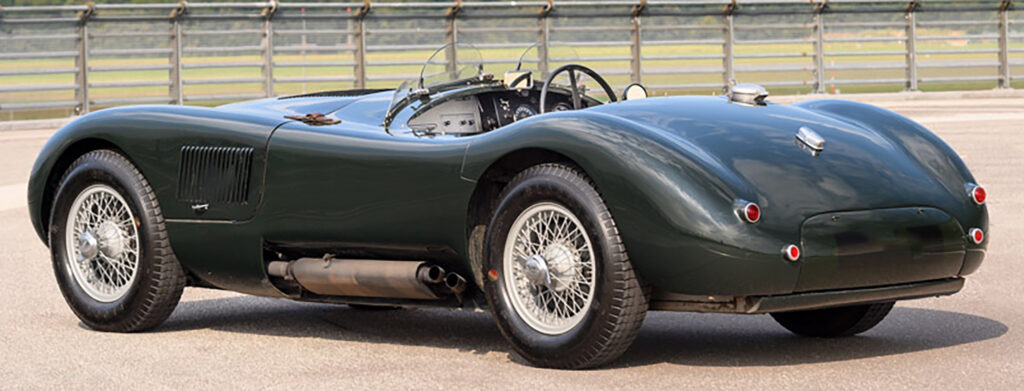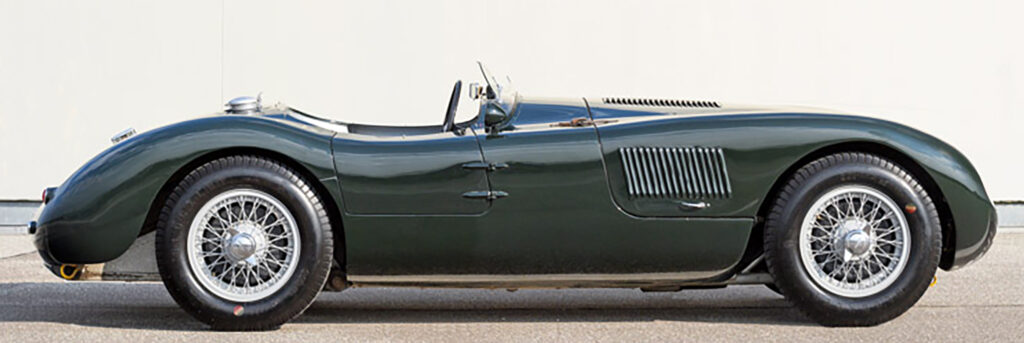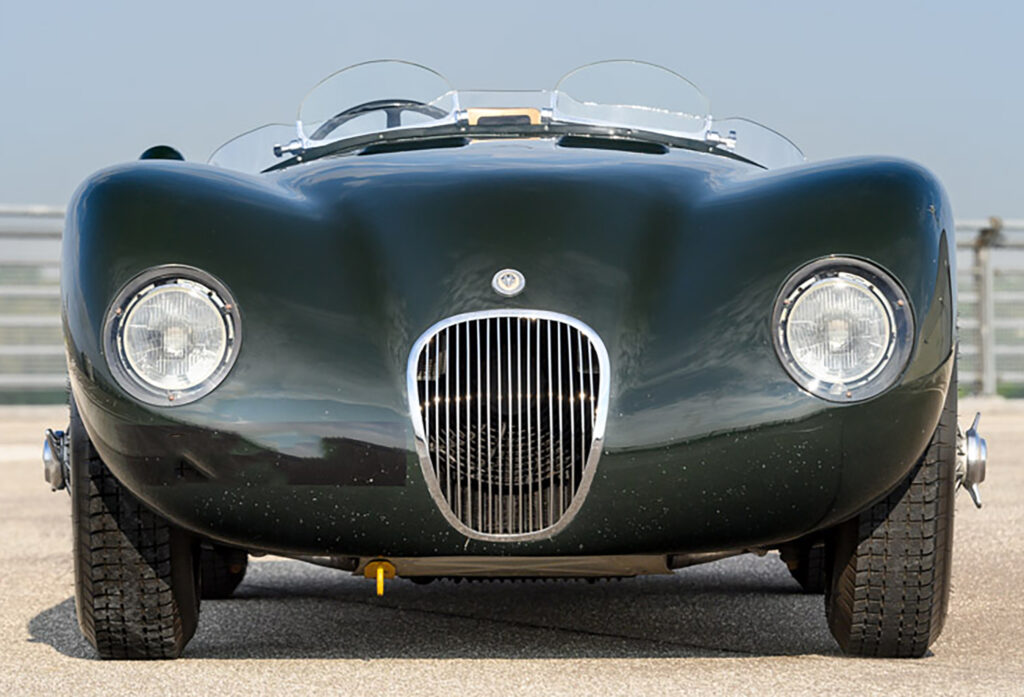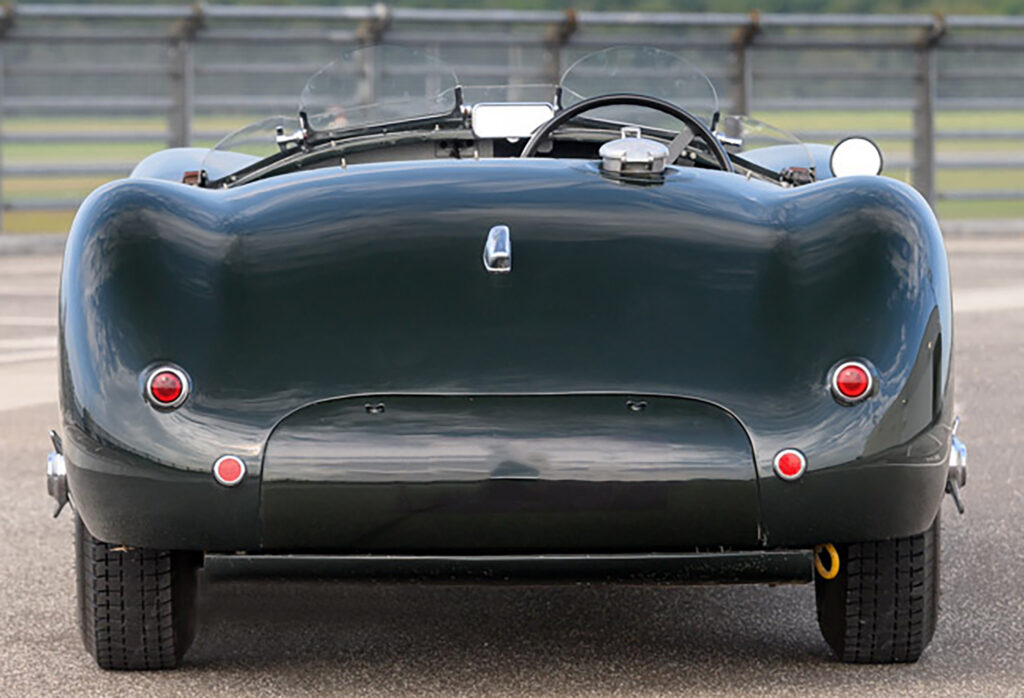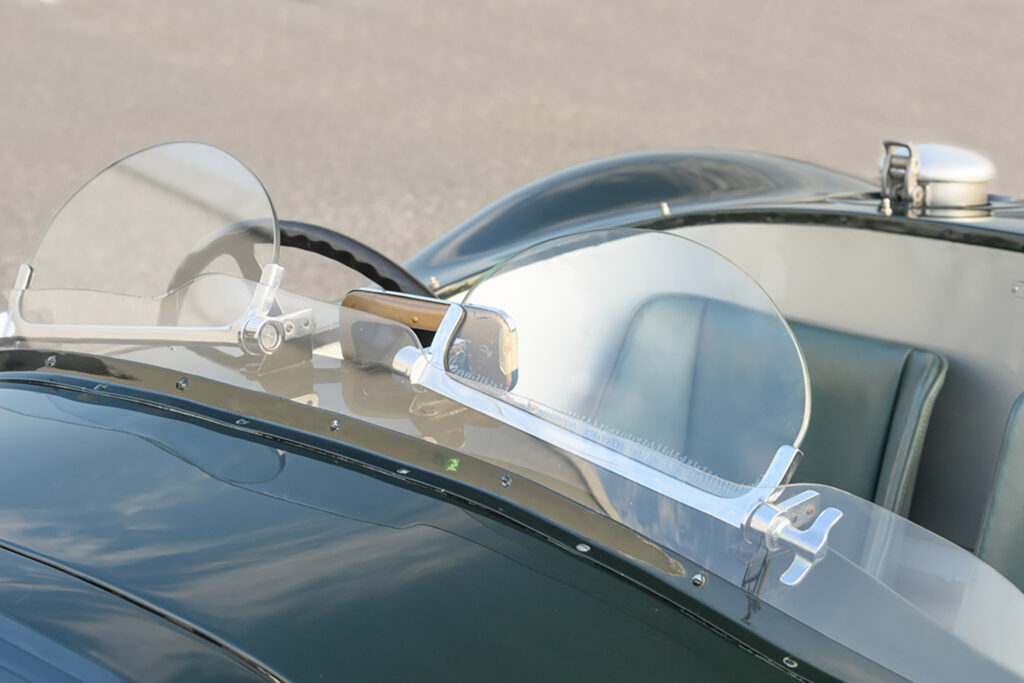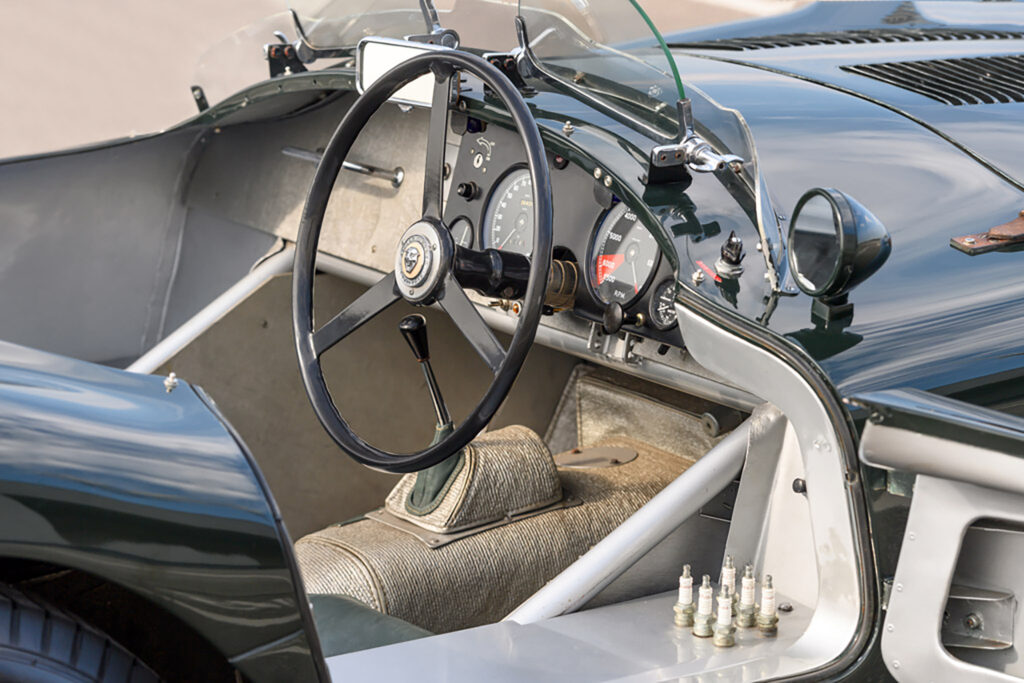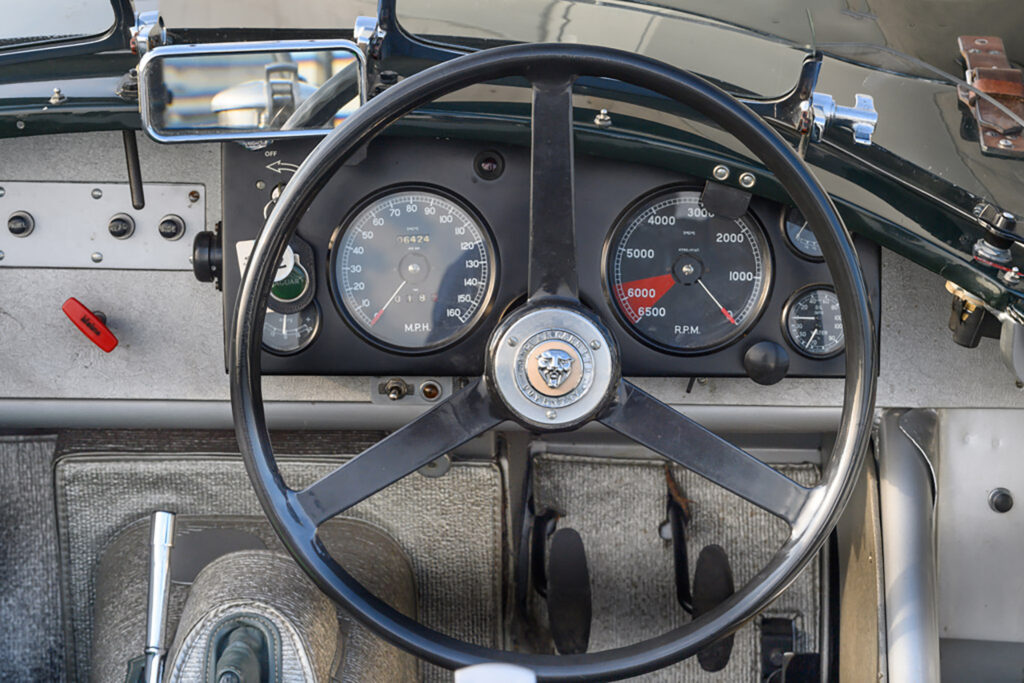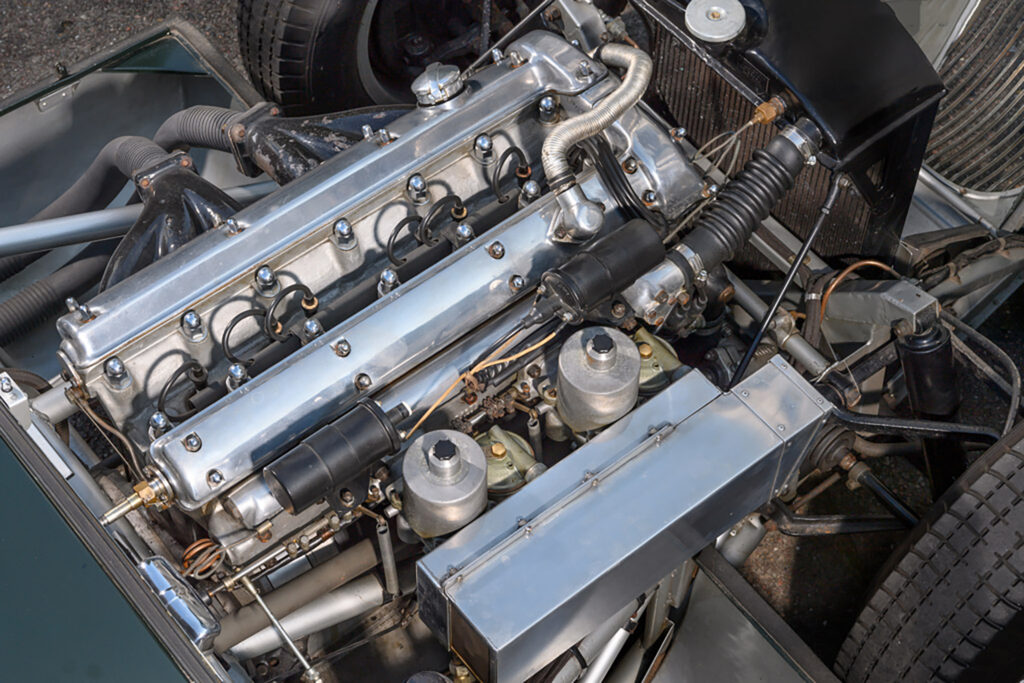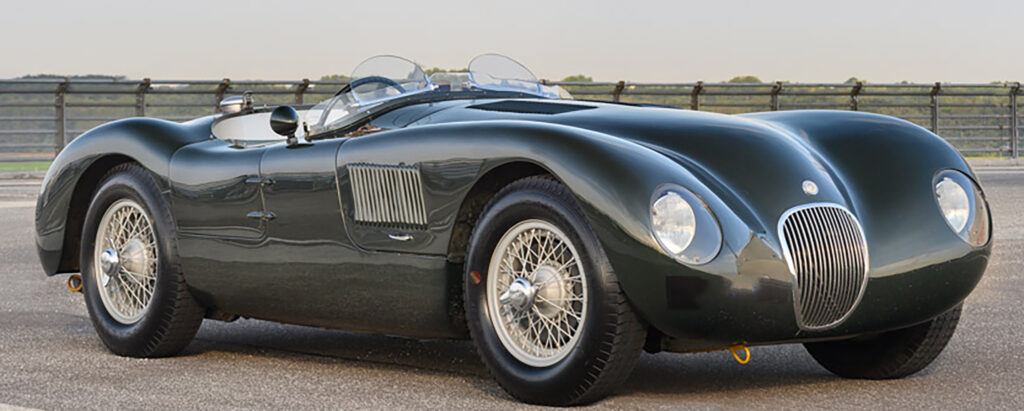
After the sweet success of Jaguar’s hurried XK120, they developed the XK120C, or C-Type, as a endurance racing version. With it, Jaguar embarked on their first racing program aimed at winning the 24 Hours of LeMans outright. On its first attempt and only six weeks after completion, Peter Walker and Peter Whitehead won Le Mans in 1951. Jaguar repeated the feat in 1953 with Duncan Hamilton and Tony Rolt at the wheel.
Motivation for the C-Type came after positive race results from the XK120 which, at the time, was the fastest production car in the world, able of reaching speeds over 120 mph. Three XK120s raced at LeMans in 1950 and proved the car was competitive enough to achieve twelfth place overall. The following year, Jaguar’s more purposeful C-Type would dominate.
At the 1951 LeMans race, three C-Types made their debut and faced stiff factory-backed competition from Talbot, Aston Martin and Ferrari. During the race, two entries retired including the team of Stirling Moss and Jack Fairman who set a record average pace of 105.2 mph. With the only remaining C-Type, Peter Walker and Peter Whitehead took the overall victory, providing Jaguar with much publicity and acclaim.
The difference between Jaguar’s 1950 and 1951 models provided quite a bit of contrast. While both the XK120 and C-Type shared the same general power train, the C-Type supported its upgraded engine with a very different chassis and body.
The C-Type replaced the XK120’s steel ladder-type frame with a new tubular design engineered by Bob Knight from 16-gauge tubing with drilled channel-section members and triangulated support. Covering this new chassis was a curvaceous aluminum body designed by aerodynamicist Malcom Sayer. He left a minimum of clearances to give a small frontal area. The body could also be opened up as both the front and rear sections were one-piece.
Shortly after their Lemans victory, Jaguar made plans and to sell the C-Type as a production racecar. In total, 53 C-Types were made which resemble the works racers of 1951. These enabled privateers to buy the car for £1,500 plus purchase tax.
After winning its initial race in 1951, the C-Type, and subsequent D-Type, dominated future LeMans events. In total, five outright victories were achieved during the decade.
| type | Racing Car |
| production years | 1951 – 1952 |
| built at | Conventry, England |
| body stylist | Malcom Sayer |
| engineers | Bob Knight |
| production | 54 |
| price $ | $ 6,000 |
| price £/td> | £1,500 |
| engine | Inline-6 |
| position | Front Longitudinal |
| aspiration | Natural |
| valvetrain | DOHC |
| fuel feed | Horizontal Twin SU Carburetors |
| displacement | 3442 cc / 210.0 in³ |
| bore | 83 mm / 3.27 in |
| stroke | 106 mm / 4.17 in |
| compression | 8.0:1 |
| power | 156.6 kw / 210 bhp @ 5800 rpm |
| specific output | 61.01 bhp per litre |
| bhp/weight | 220.36 bhp per tonne |
| body / frame | Aluminum over Tubular Frame |
| driven wheels | RWD |
| front tires | 6.5×16 |
| rear tires | 6.5×16 |
| front brakes | Drums |
| rear brakes | Drums |
| front wheels | F 40.6 x 15.2 cm / 16.0 x 6 in |
| rear wheels | R 40.6 x 15.2 cm / 16 x 6 in |
| steering | Rack & Pinion |
| f suspension | Wishbones w/Torsion Bar Springs, Hydrualic Shocks |
| r suspension | Rigid Axle w/Torsion Bars |
| curb weight | 953 kg / 2101 lbs |
| wheelbase | 2438 mm / 96.0 in |
| front track | 1295 mm / 51 in |
| rear track | 1295 mm / 51 in |
| length | 3988 mm / 157 in |
| width | 1638 mm / 64.5 in |
| height | 978 mm / 38.5 in |
| transmission | 4-Speed Manual |
| top speed | ~225.3 kph / 140.0 mph |
| 0 – 60 mph | ~8.0 seconds |
| 0 – 100 mph | ~20.0 seconds |
| key drivers | Stirling Moss, Peter Walker, Peter Whitehead, Duncan Hamilton, Tony Rolt |
| race victories | 1951 Le Mans 24, 1953 Le Mans 24 |