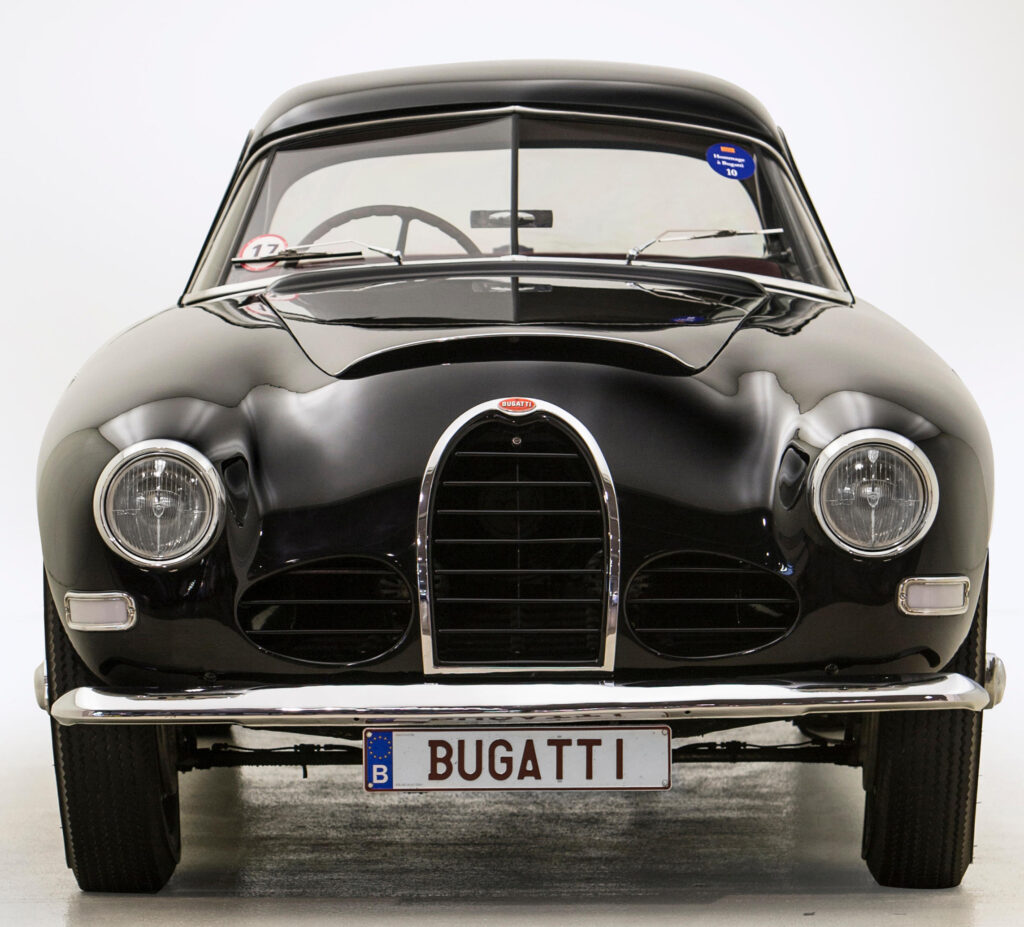
World War II and its aftermath caused Bugatti to fall into financial disarray at the close of the 1940’s, spelling the end of Ettore Bugatti’s enterprise. The Molsheim facilities had been ruined by the retreating Germans after been occupied by the Reich to build torpedoes and Hans Trippel’s amphibious vehicles and its personnel and machinery had been whipsawed back and forth across France by successive wartime regimes. Ettore Bugatti was isolated in Paris, and judged a belligerent by the post-war government because of his Italian citizenship and his property was then stripped of. His death in 1947, at 58 years old, ended up splitting the remains of the Bugatti enterprise along his heirs from both marriages.
Nevertheless, not only to honor its tradition but also apparently from a sense of duty felt by the family, the workers, and the designers who had labored under le patron’s influence, Bugatti once more emerged from the wrecks. In 1947 Paris Salon, Bugatti showcased the Type 73; a one liter supercharged design intended both as a road and racecar. This was, however, too ambitious for the Molsheim facility to build in quantity and it never passed the prototype stage.
Four years passed in which the family partially settled its differences and the Molsheim works were rebuilt, supported by orders from the French railways for parts and service on the Royale-engined Bugatti railcars, subcontract production of weaving looms, castings and machining work for Citroën. But the Bugatti automobile remained central to the Bugatti tradition and general manager, Pierre Marco, along with Roland Bugatti – the youngest of Ettore’s children from his first marriage – created the Type 101, essentially based on the Type 57 chassis but with an updated 3.3-litre supercharged straight-eight engine. The improvements included a downdraught Weber carburetor to replace the obsolete prewar Stromberg and an electric Cotal gearbox. Its coachwork, however, was thoroughly modern, including the then-modern pontoon fenders, owing only a curved and stylized Bugatti horseshoe radiator grille to classic Bugatti designs.
The Type 101 was presented at the 1951 Paris Salon, of which two examples were shown. These were a convertible and a coupe, both bodied by Gangloff. However, the Type 101’s faith was determined not by its character or appearance but by Bugatti’s decision to leave the Type 57 engine’s displacement intact, putting it in a 17 cheveaux vapeur fiscal horsepower class which imposed confiscatory annual taxes under post-war French regulations. Only eight Type 101s were ever built. The chassis 101 504 would then be sent to Antem of Paris and become the unique Type 101 C Antem Coupé, arguably the most striking and beautiful Type 101.
| type | Series Production Car |
| built at | Molsheim, France |
| body stylist | Van Antem |
| coachbuilder | Antem |
| engineers | Pierre Marco, Roland Bugatti |
| production | 1 |
| predecessor | 1935 Bugatti Type 57S Prototype |
| engine | Inline-8 w/dry sump lubrication |
| position | Front Longitudinal |
| aspiration | Bugatti Roots-type Supercharger |
| block material | Iron Alloy |
| valvetrain | DOHC, 2 Valves per Cyl |
| fuel feed | Downdraft Webers |
| displacement | 3257 cc / 198.75 in³ |
| bore | 72 mm / 2.8 in |
| stroke | 100 mm / 3.9 in |
| compression | 8.5:1 |
| power | 149.1 kw / 200 bhp @ 5500 rpm |
| specific output | 61.41 bhp per litre |
| redline | 5500 |
| body / frame | Steel body over Steel ladder frame |
| driven wheels | RWD |
| wheel type | 17 inch Wire wheels |
| front brakes | Drums |
| rear brakes | Drums |
| steering | Worm & Roller |
| f suspension | Semi-Indpenedant Centrally Collared Axles w/de Ram Shock Absorbers, Leaf Springs |
| r suspension | Solid Axle w/de Ram Shock Absorbers, Quarter-EllipticLeaf Springs |
| wheelbase | 2979 mm / 117.3 in |
| front track | 1349 mm / 53.1 in |
| rear track | 1349 mm / 53.1 in |
| transmission | Cotal electrically-controlled gearbox |