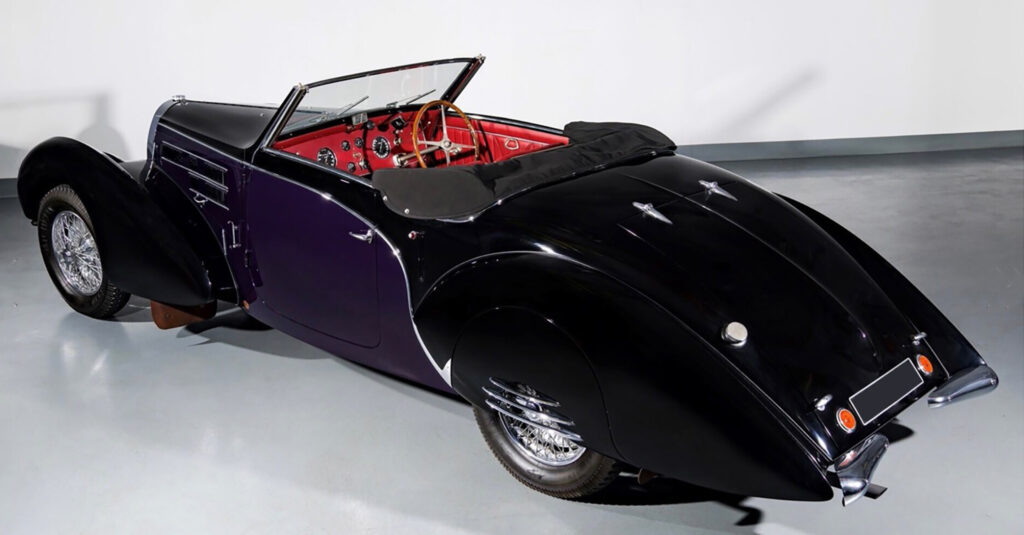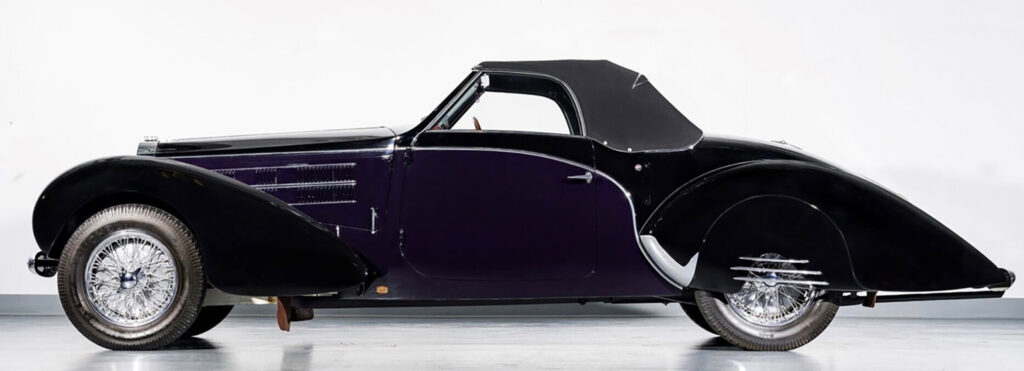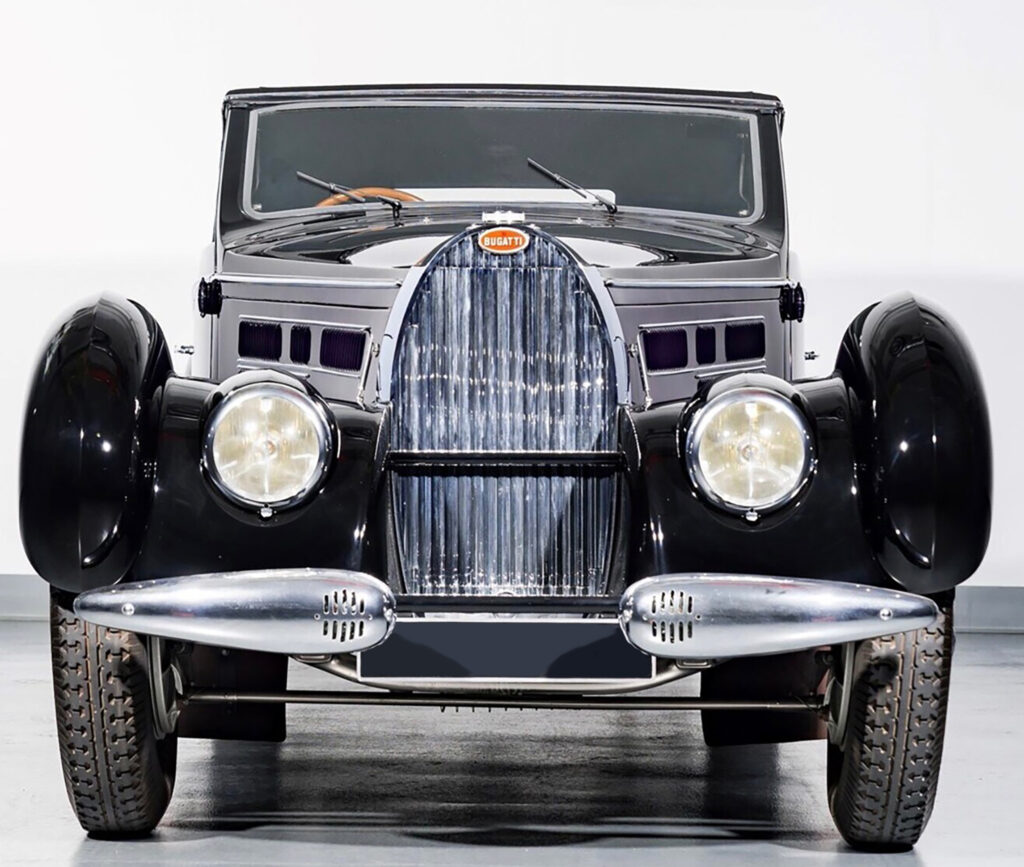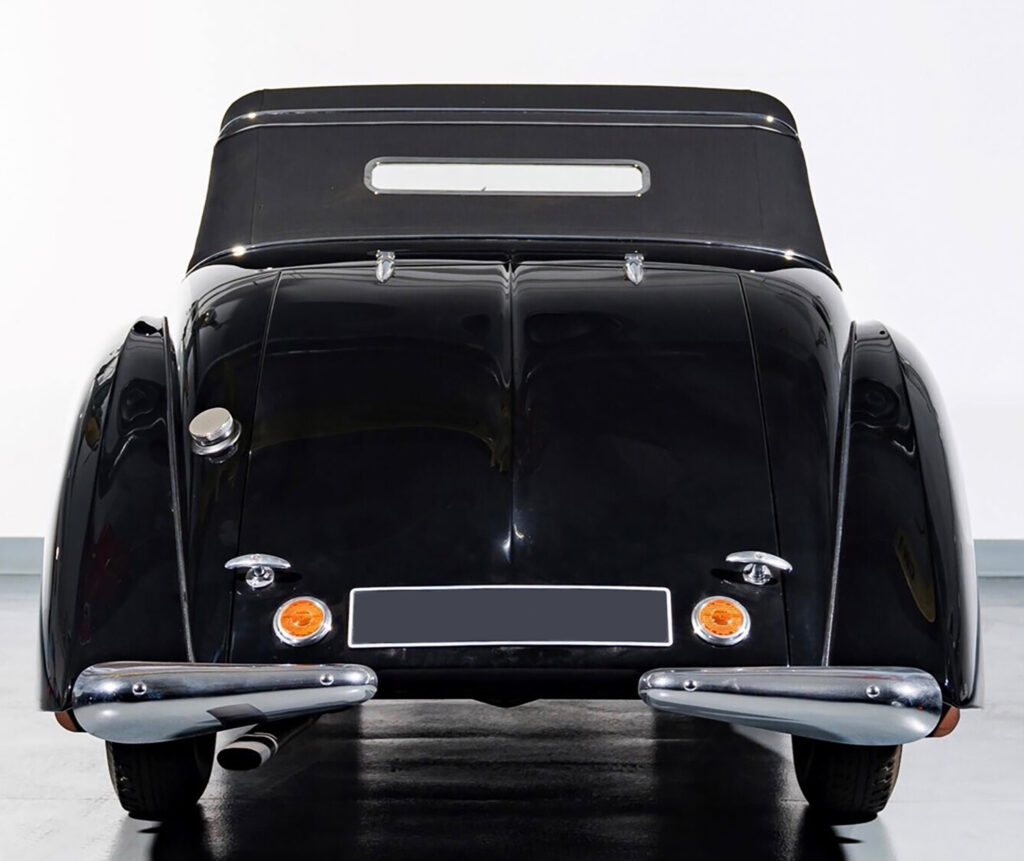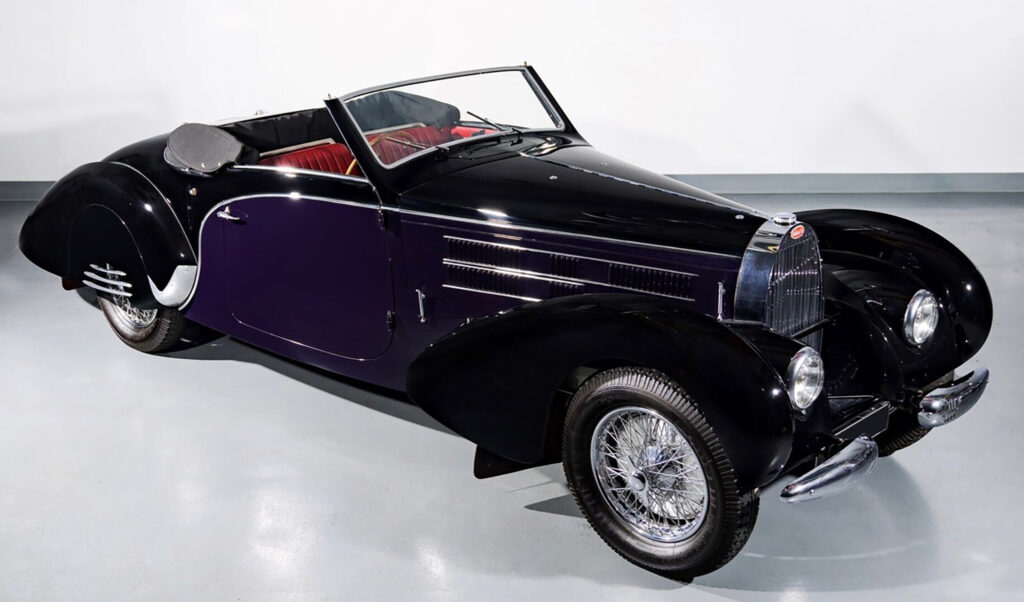
Although appearing like a Bugatti Atalante, this special coupe is not one. Instead, it is a custom order produced by Carrosserie Gangloff that used many of the familiar lines of the Atalante which was produced exclusively by Bugatti. In many ways Gangloff improved the design. This is especially true of the extended tail and reshaped rear fenders. As a result, the profile is much more balanced and striking than the typical Atalante.
This car was first ordered by Dr. André Chauvenet who was a senior surgeon at the Thouars hospital near Poitiers. This was his fourth Bugatti and it was ordered at the request of his wife as a two-seat coupe from Gangloff in January of 1937.
The basis for this remarkable car was Bugatti’s top-of-the-line Type 57S chassis. These were the same type that Jean-Pierre Wimille and Robert Benoist drove to win the 1937 24 Hours of Le Mans. It had a much lower chassis than the preceding Type 57 and also used complex de Ram shock absorbers. In many ways this was the ultimate Bugatti since no logical successor was ever produced.
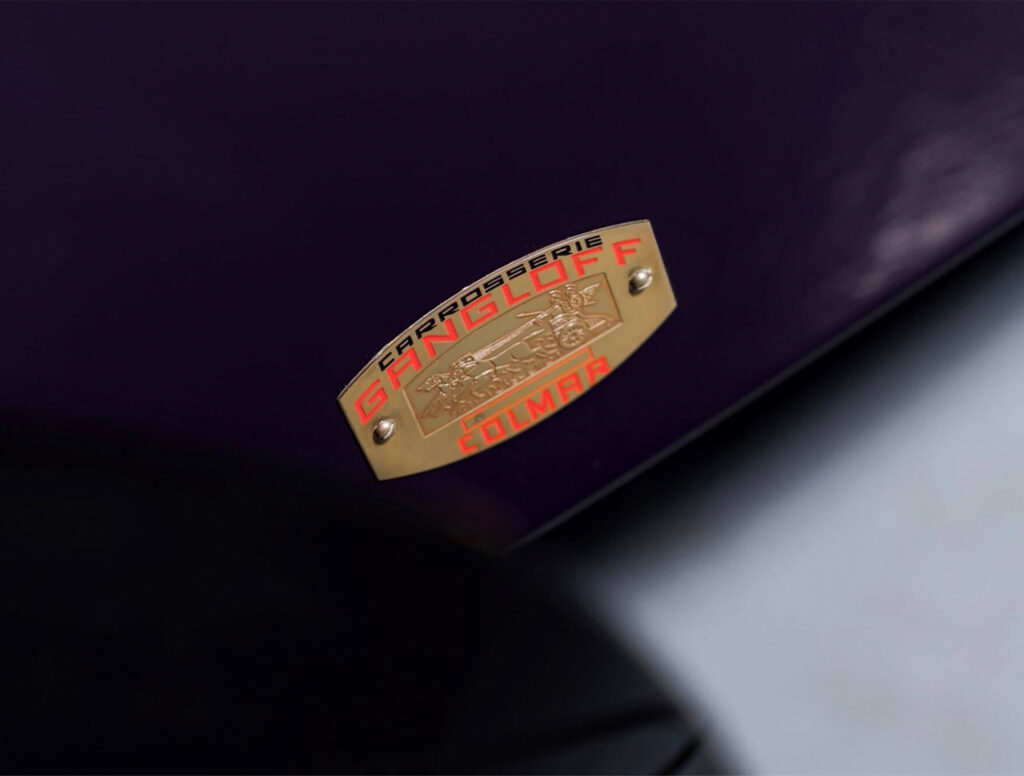
Gangloff was a Swiss and French company that designed out of Geneva, Zurich, Berne and Colmar, France. The later was the site for Carrosserie Gangloff which built many of Bugattis most opulent bodies. This included chassis 57532 which was sent to Gangloff in late April for its bodywork. Mr Chauvenet specified Black paint over tan pigskin upholstery with ‘AC’ monograms on each door. His car was much different than the standard Atalante. A profile comparison reveals reshaped fenders and extended rear fenders with long overhangs.
Mr Chauvenet used his car for 15,000 kms, frequently driving one of the most exclusive French cars to the hospital where he worked. Later the car passed to Dr. Dinoire who planned to make a race car from Coupe. He removed the body, but no further work was done until after the war.
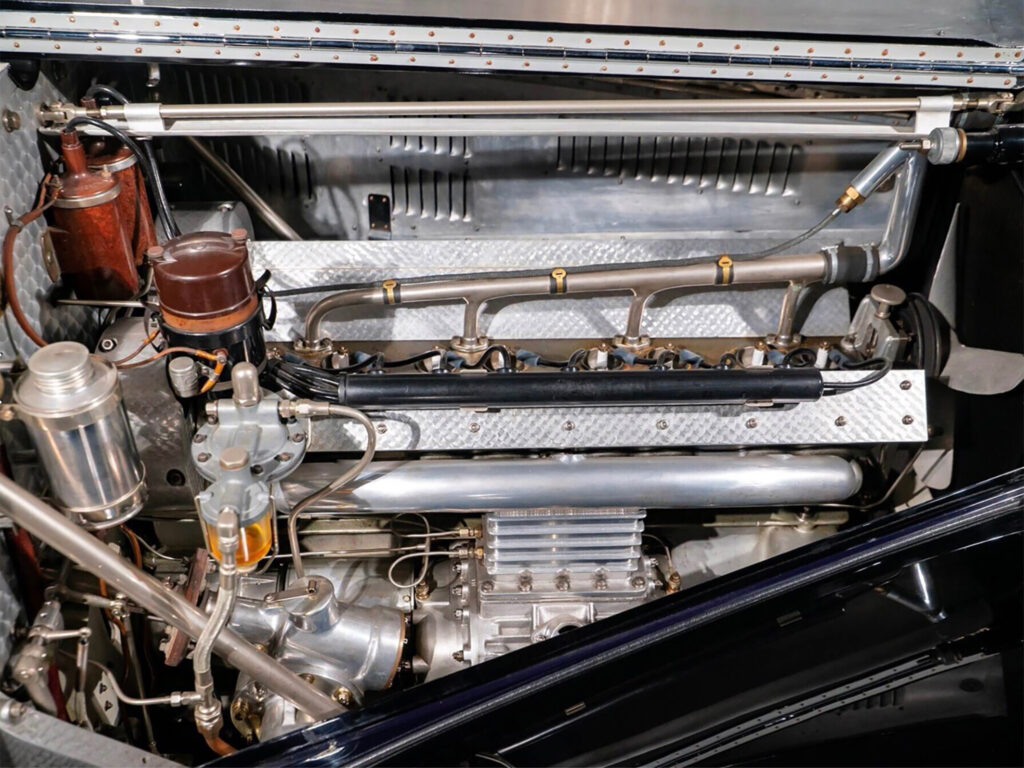
By 1943, the car was completed again and sold to Danish/French singer/songwriter Georges Ulmer who at the time had the hit single ‘Pigalle’. After three more owners it passed through the remarkable collection of Michel Seydoux who had it restored by Lecoq in the mid 1980s. By 2004 the interior was reupholstered, engine rebuilt and de Ram shock absorbers overhauled. Still in very presentable condition it was displayed for to the public for the first time at the 2008 Villa d’Este Concours.
Not long after the show it was announced by Bonhams that the car would be sold at their 2009 Pebble Beach Auction. They described it as a car that could “sit comfortably on the most exclusive concours d’élégance lawns world-wide but would also perform impeccably at high speed”. For publicity it was displayed at the 2009 Retromobile.
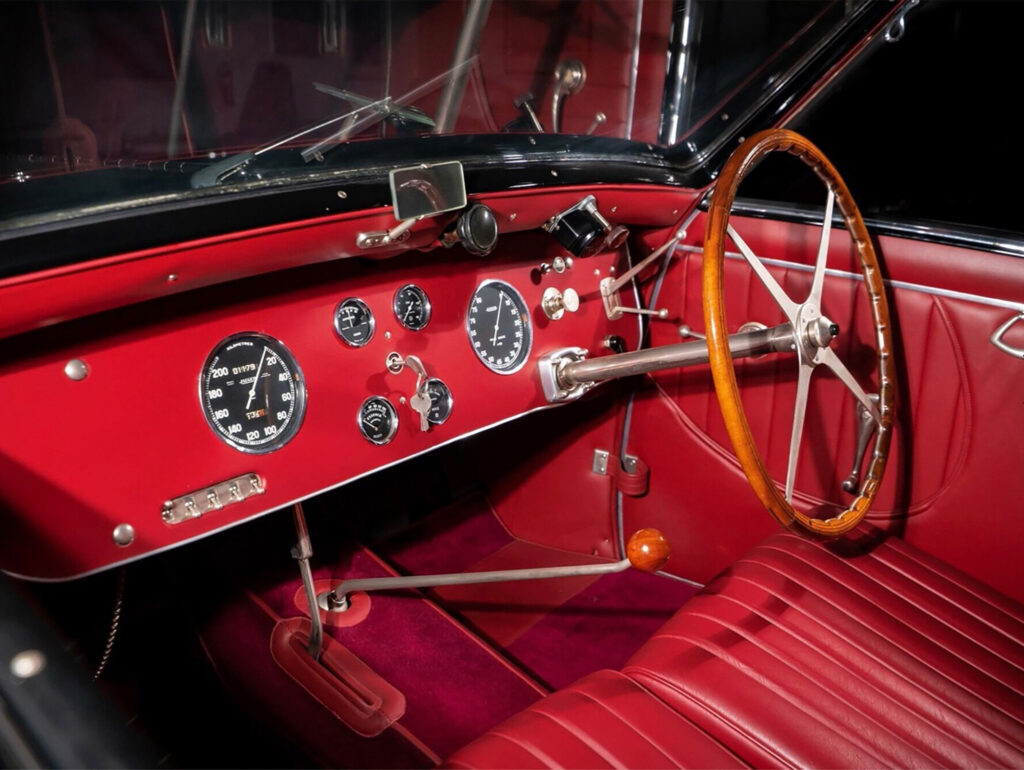
Furthermore, Bonhams said “On Concours lawns there are few more spectacular and exotic pre-war coupés than 57532, its Jean Bugatti-influenced coachwork now gently understated in its black livery with fine gold coachlining and the snug interior superbly appointed with brown leather upholstery and black carpets. Of particular note are the fine wood surrounds and cappings in the interior – Gangloff attention to detail at its very best. Driving equipment includes Marchal Equilux headlamps with Marchal side lamps, a fine blade front bumper with over-riders, a Tenor Cicca trumpet horn mounted beneath the bonnet and the near-side front wing incorporates a 14-liter capacity oil tank. Dashboard instrumentation is all correct and working and features a Jaeger 0-200kph speedometer, Jaeger amperes meter, a Bugatti Telefix essence gauge, oil pressure and water temperature gauges and a Jaeger 0-8,000rpm rev counter. Interior furnishings include a tilting interior mirror, courtesy light and sun visors, while a scuttle-top ventilator provides cabin cooling and passenger comfort. The car sits on 18 inch Dunlop Racing tires.”
| type | One off |
| production years | 1937 |
| built at | Molsheim, Alsace, France |
| body stylist | Jean Bugatti |
| coachbuilder | Carrosserie Bugatti |
| engineers | Jean Bugatti |
| production | 1 |
| predecessor | 1936 Bugatti Type 57SC Atlantic |
| engine | Inline-8 |
| position | Front Longitudinal |
| aspiration | Roots-Type Supercharger |
| block material | Cast Iron |
| valvetrain | DOHC, 2 Valves / Cyl |
| fuel feed | Stromberg Carburetor |
| displacement | 3257 cc / 198.8 in³ |
| bore | 72 mm / 2.83 in |
| stroke | 100 mm / 3.94 in |
| power | 156.6 kw / 210 bhp @ 5500 rpm |
| specific output | 64.48 bhp per litre |
| bhp/weight | 135.48 bhp per tonne |
| body / frame | Steel over Steel Frame |
| driven wheels | Front Engine / RWD |
| front brakes | Hydraulic Drums |
| rear brakes | Hydraulic Drums |
| front wheels | F 45.7 x 14.0 cm / 18.0 x 5.5 in |
| rear wheels | R 45.7 x 14.0 cm / 18.0 x 5.5 in |
| f suspension | Beam Axle w/Semi-Elliptic Leaf springs, De Rams Shock Absorbers |
| r suspension | Live Axle w/Reversed Quarter-Elliptic Leaf springs, De Rams Shock Absorbers |
| curb weight | 1550 kg / 3418 lbs |
| wheelbase | 2980 mm / 117.3 in |
| front track | 1350 mm / 53.1 in |
| rear track | 1350 mm / 53.1 in |
| length | 4600 mm / 181.1 in |
| width | 1760 mm / 69.3 in |
| height | 1380 mm / 54.3 in |
| transmission | 4-Speed Manual |
| top speed | ~210 kph / 130.5 mph |
| 0 – 60 mph | ~10.0 second |